
What happens in your body when your glucose spikes too often. Even Without Diabetes
In this blog, I want to explain what repeated glucose spikes actually do inside your body, why this matters for people with diabetes as well as those without, and how understanding your own glucose patterns can help you make calmer and more informed choices.
Many people think glucose is only an issue if you have diabetes. Or only when you eat sugar.
In reality, it is more nuanced than that.
People without diabetes also experience glucose spikes. That is normal. After every meal, blood glucose rises. Your body uses glucose as fuel. Afterwards, levels should return to baseline.
It becomes relevant when those spikes happen frequently, rise high, or stay elevated for a long time. Then it is no longer about a single moment, but about a pattern. And that pattern says a lot about how your body handles energy.
 A glucose spike is not automatically a problem
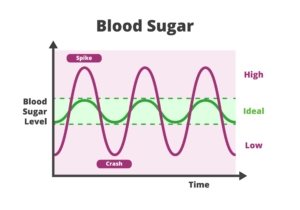 A glucose spike is not automatically a problem
First, an important clarification. A rise in glucose after eating is part of normal physiology. Your body releases insulin and clears glucose from the bloodstream. For most people, this process works well.
Issues arise when this system has to work harder and harder, or becomes less efficient. Glucose levels start to fluctuate more. They rise and fall repeatedly throughout the day. Researchers call this glycaemic variability. It is not about the average value, but about how unstable the curve is.
Two people can have the same average glucose or HbA1c, while one has relatively stable levels and the other experiences constant peaks and dips. Standard blood tests do not show this difference. Continuous glucose monitoring does.
What repeated glucose spikes do inside your body
When glucose levels are repeatedly high, even temporarily, more happens than just energy delivery.
Research shows that acute high glucose can temporarily impair the function of blood vessels. They become less flexible and respond less effectively. This effect is reversible, but when it occurs frequently, it becomes biologically relevant.
Repeated glucose spikes are also associated with increased oxidative stress. This is a form of cellular stress that the body can manage, but not endlessly. That is why modern metabolic research looks beyond fasting glucose and focuses on postprandial responses: what happens after you eat.
The key issue is not one spike. It is repetition over time.
Why this matters even if you do not have diabetes
Many people without diabetes feel generally healthy, yet notice that they feel sluggish after meals. Or they experience energy crashes and renewed hunger shortly after eating.
These effects can be linked to rapid rises and falls in glucose. A sharp spike may be followed by a relatively fast drop, which feels like an energy dip. The body then signals a need for more fuel, often leading to cravings or snacking.
An increasing number of studies show that these patterns also occur in people without diabetes, especially in the context of chronic stress, poor sleep, low physical activity, or highly processed diets.
This does not mean something is “wrong”. It means the metabolic system is under more strain than necessary.
Why glucose variability is especially important for people with diabetes
In people with diabetes, the impact of glucose spikes and variability is much better documented. Large fluctuations place additional stress on the body and are linked to long-term complications.
That is why diabetes care is increasingly focused not only on average glucose or HbA1c, but also on stability. How much time is spent within a target range? How often do levels rise too high or fall too low?
Stability turns out to be just as important as the average.
Why “healthy food” can still cause glucose spikes
This surprises many people. They eat what is considered healthy, yet still see sharp glucose rises.
Liquid meals such as smoothies are absorbed quickly. Foods like oatmeal, granola, or whole-grain bread can also trigger significant postprandial glucose spikes in some individuals, especially when eaten on their own.
Stress and sleep quality play a major role as well. Poor sleep or prolonged stress can increase glucose levels because the body releases glucose from the liver, even without food intake.
This is why glucose regulation is not just about nutrition. It is about lifestyle, timing, recovery, and context.
What you can do without extreme dieting
The good news is that small changes often make a meaningful difference. Eating more slowly. Combining carbohydrates with protein and fat. Light movement after meals. Improving sleep where possible.
The goal is not perfection. The goal is to reduce unnecessary strain on your system.
Most importantly, responses are individual. What works well for one person may have little effect for another. That is where measuring becomes valuable. Instead of guessing, you see how your own body responds.
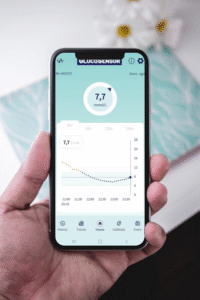
Why insight makes the difference
Many people try different diets, cut sugar, or change routines. Without insight into their actual glucose patterns, these efforts remain trial and error.
By tracking glucose, patterns become visible. You learn what gives you stable energy and what triggers unnecessary spikes. This is relevant for people with diabetes, but equally for those who want to improve focus, energy, and long-term metabolic health.
The goal is not a perfectly flat line. The goal is understanding what your body needs.
In summary, glucose spikes are normal. Frequent spikes are informative. They tell you something about how your body handles energy, stress, sleep, and recovery. With the right insight, you can make calmer, smarter, and more personal choices.